On Adventuring
“What did you do over summer, Shannon?” my third-grade teacher asked. We were going around the room at the start of a new school year, sharing about our vacations.
“We camped on Catalina, but not on the side with all the people—on the side with all the buffalo. And we jumped off our favorite cliff and ate fish my dad caught spearfishing! It was awesome!”
My teacher and classmates looked at me wide-eyed, unsure how to respond.
“So, no trips to the mall then, I’m guessing,” another little girl offered, trying to fill the silence. “Uhh…no. No malls.”
“What did you do over summer, Shannon?” my third-grade teacher asked. We were going around the room at the start of a new school year, sharing about our vacations.
“We camped on Catalina, but not on the side with all the people—on the side with all the buffalo. And we jumped off our favorite cliff and ate fish my dad caught spearfishing! It was awesome!”
My teacher and classmates looked at me wide-eyed, unsure how to respond.
“So, no trips to the mall then, I’m guessing,” another little girl offered, trying to fill the silence. “Uhh…no. No malls.”
Even swapping weekend stories landed me in the same awkward spot.
“We hiked and we saw a rattlesnake and my dad killed it with a big rock. Oh, and my little brother got poison oak. Again.” Or, “We grilled the leopard shark my dad caught, and the meat kept moving even after my dad cut it apart.”
My classmates would take turns guessing what new adventure we had gone on that weekend or holiday break. It didn’t take me long to realize we were not exactly like other families. The kid who did crazy stuff was a badge I wore proudly.
With a little distance from my childhood, I can see more clearly now two parents who had been told by their Huntington’s Disease doctors to go and live their lives to the fullest for as long as my mom could. And they did. Man, they did.
Let me offer a little background on what is a rare and often little-known condition. Huntington’s is genetic. Each kid has a 50 percent chance of getting it from a parent who has it. My grandpa got it from his mom and passed it down to my mom.
Doctors and scientists have mapped where the genetic mutation occurs. A DNA segment that repeats itself 10 to 35 times in healthy humans, for some reason, repeats itself 36 or more times in Huntington’s patients. The result? An overproduction of the Huntingtin protein and the slow breakdown of muscles and brain cells.
The simplified explanation borrows from more well-known diseases. Take Parkinson’s, ALS, and Lou Gehrig’s disease, combine them—then stretch them out over two to three decades—and that’s Huntington’s, or HD, as it is also known. Though researchers continue to make huge strides in HD treatments, it is 100 percent fatal and has no known cure.
While each of us must rest in the truth that God alone knows the number of our days, we also could see pretty clearly that, unless He chose to heal my mama on this side of the grave, the clock on her mobility, and on her life, was ticking fast.
So, my parents took us kids and filled my mom’s healthier years with remarkable adventures.
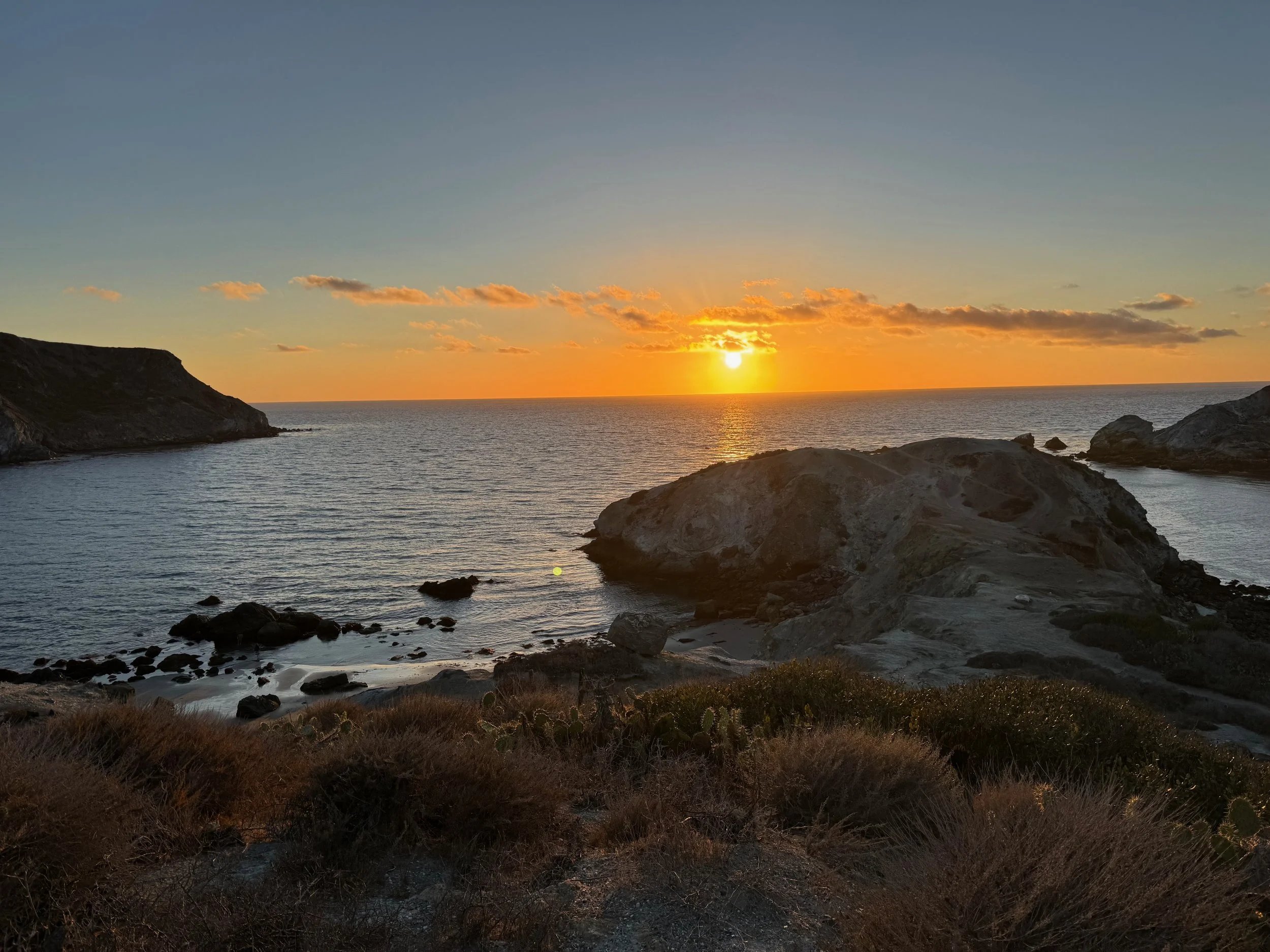
Little Harbor, on the remote side of Catalina, was hands down my mom’s favorite place. The buffalo, brought over for a film in the 1920s, roam free on the back side of the island. Campsites with picnic tables dot the hillside and valley near the harbor. And every year in early August, after my dad finished summer school, but before the school year started for my teacher parents, we would claim campsite #17 for a week.
All six of us would take the ferry to Avalon with all our gear. My older sister, Annie, was super into fashion and looking cool. She would tell us repeatedly she wished the ground would open up and swallow her as we dragged spearguns, tents, and sleeping bags up the ferry ramp at Avalon. An hour-long, windy van ride later, we were there, looking out at the endless ocean with almost no one else around.
Our weeks were full of spearfishing for my dad and me, playing in the waves for my siblings, and kayaking for my mama. We would somehow lug her baby blue single kayak, lovingly named, Jemima Puddleduck, with the rest of our gear. My mom logged countless hours in her kayak, toting granola bars and water bottles for the rest of us in the ocean.
No trip was complete without cliff jumping at least once each day, usually two or three times though. A shaly rock offered the highest jump for those brave enough to sort of slide down the edge of it and jump out to avoid the rocks below. I may or may not have gotten stuck on this shaly ledge, unable to push out to jump safely. And, I may or may not have forced my dad to swim 100 yards back to shore, then hike up the hill to rescue me.
I knew better than to let the fear of that unconquered cliff fester, so later that day I dragged my dad back to it. Before I could change my mind, I ran off the ledge, cleared the rocks, and landed with a satisfying splash in the crisp water below.
Although Catalina was our go-to, one summer, my parents decided to change it up, and drive up the California coast, camping along the way until we reached the Jed Smith River at the California-Oregon border.
We loaded into our gold 1980s Dodge Ram van, dubbed the Luv Van. Much to our chagrin, our parents bought this mint condition van off an older couple who hardly used it. Complete with gold carpet, gold seats, and even gold curtains, it also sported hideous brown stripes down both sides.
The license plate actually had the letters “LUV” on it. The four captain’s chairs inside were surprisingly comfortable. However, my seat in the middle row behind my dad did not have a window, making a road trip rather frustrating when everyone else is commenting on how amazing the scenery is along the way.
We pulled in after dark to our first stop, pitched our tents to get some rest, only to get woken up in the middle of the night by rain soaking through our tents, our sleeping bags, and our PJs. Freezing, we ran for cover to the Luv Van, and tried to sleep a few more hours.
The sun came out the next morning, and we dragged our piles of wet laundry to the closest laundromat. While our gear dried, we found an all-you-can-eat pancake breakfast at a local fast food place and dove into those hearty stacks with abandon.
We did eventually make it to our destination in Jed Smith and set up camp for a week of fun along the river. We found some pretty epic jumping rocks and took turns doing crazy stunts off of them. One morning, my mom drove my dad and us four kids to the top of the river and dropped us off. My dad had been told it was a popular spot for white water rafting and we could see groups getting into their big rafts to head downstream.
My dad motioned for us to come closer. Out of a plastic bag, he produced five pool rafts my mom had bought from the dollar store.
“Everyone, blow up your rafts—we’re going to float down the river,” he explained.
So we did. Surely dad knows what he’s doing—he’s probably done this before, right? We hit our first rapid, which was pretty sharp going over on a pool floatie. I glanced over at my dad for reassurance and saw an unfamiliar sight—his eyes were wide with fear. He started shouting directions for us to try to go over the calmer parts of each rapid and stay together.
One cold, tumbling rapid after another, we made painful progress downstream. A few hours later, we crawled out of the river, frozen and stiff. We were down two pool rafts, which had popped along the way. But, we made it. My mom made mac-n-cheese over the fire that night—it was hands down the best meal I had ever had in my short life.
Those adventures and so many others from my childhood are seared in my memory, much-needed breaks from the awful reality of watching my mom deteriorate. Most kids, up to a certain age, do life fairly unaware of the mental and emotional weight the adults are carrying—and they should.
My parents tried hard to keep us from carrying the weight of my mom’s diagnosis, but it was unavoidable. It found its way into everything we did. No matter how incredible the moment, it was always followed by the sobering thought that mom wouldn’t be able to do these things much longer.
The weight came with gifts attached though—transformative, gracious gifts. Our family simply saw life differently—the world around us seemed sharper, clearer. Time was marching steadily on, despite our best efforts to slow it down. We seized opportunities to go and live with a zest I did not see in many others. My parents were not about making tons of money or climbing any earthly ladders of success. My mom was leaving us altogether too quickly. So we paused, reveled, and wondered in a way others did not have the capacity for.
When my mom’s condition worsened and the grief of caring for her felt it might crush us, my dad and I would get up before the sun, and head for the beach. Joining the lineup of surfers in the water as the first rays of light flashed over the horizon soothed our weary souls.
It was not simply the beauty around us, but a grace-filled reminder from the One who made it all. The One who made us, and who made my sweet mama. The sunrise each morning, and the tides coming in and going out, coming in and going out shouted glory to a God whose faithful hands were in every detail.
He was holding it all together—and He was holding my family, too.
On Suffering
My mom loved and trusted Jesus from an early age. She threw herself into everything she did with her whole heart—whether school, playing clarinet in the band, backpacking, or adventuring. But she most deeply cared about introducing others to her Jesus.
She and my dad would eventually take that love for Jesus and His people around the world to Indonesia, where they served as missionaries in Jakarta for a little more than two years. I was only 1 year old when we made the move overseas. My dad officially taught English, but they were really meeting the community and hosting Bible studies in their home, sharing Jesus however they could.
An Imam would climb his tower every morning, which was right behind our house, and we were woken up by the Islamic call to prayer. Although Christianity was growing at the time, Muslims still accounted for more than 85 percent of the population, and the culture was not kind to Christians.
My mom loved and trusted Jesus from an early age. She threw herself into everything she did with her whole heart—whether school, playing clarinet in the band, backpacking, or adventuring. But she most deeply cared about introducing others to her Jesus.
She and my dad would eventually take that love for Jesus and His people around the world to Indonesia, where they served as missionaries in Jakarta for a little more than two years. I was only 1 year old when we made the move overseas. My dad officially taught English, but they were really meeting the community and hosting Bible studies in their home, sharing Jesus however they could.
An Imam would climb his tower every morning, which was right behind our house, and we were woken up by the Islamic call to prayer. Although Christianity was growing at the time, Muslims still accounted for more than 85 percent of the population, and the culture was not kind to Christians.
While in Indonesia, my parents were surprised to learn they were expecting my little brother. My courageous mama took it in stride and had my brother in a clinic of sorts, where she had to tell the doctors what to do the whole way through her delivery.
My parents came home on furlough to raise support after my brother was born. Their missions organization actually ended up asking them not to return to Indonesia, which was heartbreaking and humbling for them both.
My mom had already become pretty challenging to work with—the early stages of her Huntington’s setting in. Stress is a known aggravator of the disease and she had been living in a pressure cooker situation with first three, then four little kids for more than two years.
I know they were glad to come home to the States, especially to be with family and friends, but their hearts were still overseas. Missions remained a huge focus in our home, with kids sponsored through World Vision, and missionaries on furlough welcomed over often. My parents even launched one missionary family to Africa from their living room.
My mom also found ways to minister to others locally. She was constantly inviting people over to join our family for meals, often folks we didn’t know that well, which, let me just say, we were not fans of as kids. She made it a point to set extra places at our table for holiday meals, too, because anyone who didn’t have a place to go was welcomed into our home with joy. Some of those folks came so often, they felt like part of our family.
This mama of mine made people feel seen and like they mattered. It was incredible to watch weary souls come alive around her as she handed out the love of Jesus.
My mom was also the heart behind traditions in our home, of which there were many. Birthdays always started with goofy handwritten birthday signs all over the house. They ended with a time of going around the room sharing what we loved about the birthday person over dinner—even when the only “nice” thing we could say about our sibling was, “he let me play with his soccer ball…”
Thanksgiving included our traditional feast with verses at every place setting, which we read aloud before the meal began. It meant going around and sharing how God had moved in the last year. And Christmas had the most traditions of all—complete with a special ornament packed in a beautiful box with a note from my mom sharing verses she chose for each of us and what she was praying over each of us that year.
She could make a random Wednesday afternoon special—it was just who she was. She had a gift for celebrating and loving others well, and never missing an opportunity to point to her Jesus. Sometimes, when I think of her, it’s hard to remember what she was like before Huntington’s really took hold. But she was incredible, not without faults—like any of us, but incredible all the same. It made it even more heartbreaking to see her walk her road of suffering.
One of the most challenging parts of my mom’s Huntington’s was her emotional volatility. Declining motor skills meant everyday tasks were growing more challenging. Combine that with the steady decay of neurons in her brain, and it meant an unpredictable, illogical person was slowly replacing the mom I knew.
One of my earliest memories of her losing control toward me was at the age of 6. We were coming home from school. She had laid into my sisters about something they did the whole car ride and they were dishing it back, talking back to her.
We pulled in the driveway, walked up the front path and we were standing off to the side on the wide porch waiting for my mom to unlock the door. My sisters started crying on the porch, and I did, too, even though I wasn’t even part of the fight.
“Stop crying! Stop it! STOP IT!” my mom yelled. “I need no one crying right now!” She screamed.
My sisters turned the tears off instantly. I could not find the switch to make mine stop. My mom’s gaze shifted to me, sobbing at this point on the porch.
“I said STOP IT!!!” her hand shot out and smacked me across the face—hard. I ran off the porch, hiccuping sobs with both of my hands over my mouth to stifle the sound.
I threw the side gate open and lowered myself down behind some bushes in the backyard. Shaking, I pulled my hands from my face and saw they were covered in blood. My mom had broken my lip open.
When my dad came home and saw me later that evening, he didn’t even have to ask who did it. He already knew. My dad pulled me aside saying something I would hear often as a kid, “I am so sorry that happened to you. You know…that’s not your mom doing that, it’s her disease.”
It was true in a sense, but, in my mind, it was very much my mom doing it. She still looked like my mom and sounded like my mom, and even acted like my mom a good part of the time, too. I didn’t know where the disease stopped and my mom started.
We could read her mood and frustration from a mile away. And we were trained to make ourselves scarce. I spent a lot of time under the radar in my room.
The older I got, the more I tried to be strong for my dad and not break down much in front of him, since there was already plenty of that happening in our home. I saved my tears for my room, for my talks with Jesus.
I would read about Jesus healing the sick in the Gospels, and begged him to do the same for my mom. Some of my friends went to churches where they preached that God always wants to heal our physical bodies—all we have to do is pray in faith. This narrow view of God wrecked me—I had prayed for years for my mom, hundreds of faith-filled believers had, too, and…nothing. No healing.
I went through a season where the only way I could make sense of my reality and the God I read about in the Bible was by believing He was just too far away handling wars and bigger stuff or He simply did not care about my mom. A seed of bitterness against God was taking root deep in my heart. I desperately needed Him. My mom desperately needed Him and He seemed nowhere to be found.
Don’t you care, God? Don’t you see?
Night after night tears would soak my pillow as my heart cried out for answers.
I couldn’t see then, but my wrestling with God was actually tethering me to Him. By His grace I was pressing into Him in the pain. God was showing me He could be trusted.
“Come to Me, all you who are weary and heavy laden, and I will give you rest.” (Matt ___) So I did—I kept going to Jesus. And He kept meeting me, flooding my weary spirit with the truth of His Word. We serve a God who knows what it is to suffer, to hurt.
We hit a point with my mom where stuff being chucked in anger—coffee mugs, books, chairs—no longer fazed us. Thankfully it usually wasn’t thrown at us, but it still contributed to an environment of instability in our home.
My mom would scream at her hands, “Why won’t you just work???!! Just work—I need you to work!!!”
As her disease worsened, my parents finally reached out to the doctors for medication to alleviate some of her symptoms. It took a while for them to dial in the right prescriptions and the right doses for her, and things got pretty terrifying.
I would be at work and she would call me and say she was going to throw herself in front of the next truck that went by, and I could clearly hear the traffic whizzing by her.
The wrong combination of meds had made her suicidal, something she had never struggled with before, despite how badly the disease was taking her down.
We had two more scares before they got her balanced out—one was her punching through the glass window on purpose to cut her wrists, and the other, finding a kitchen knife we thought we had hidden.
I am praising Jesus we did not lose her that way. I think that would have just wrecked me completely. The doctors were able to simply stitch her up after both of those incidents.
Once we got her meds sorted out, she was closer to the mom I used to know than she had been in years. It was the sweetest gift to have a little time with her mentally more stable. Unfortunately, it went hand in hand with the worst part of her disease physically.
My dad would be at work, and he would try to make sure she had everything close by so she wouldn’t have to stand up too much without him there, but she would often fall. She would grab her cell phone and call me, and I would drive over and help pull her up.
Then, we hit a point where, even with us there to help her, it got harder and harder to move her because she could no longer help at all—she was just dead weight. I remember asking God to take her home so many times.
Why are you letting her suffer? What point could there possibly be for her to still be here—God, be merciful and let her come to You.
Whenever we would talk about what her final days might look like, my dad always made it very clear: “It is not my job to decide when to send her home to heaven. That’s God's decision and His alone.”
God made it clear to me, too, that my mom was here on earth, she had breath in her lungs, and He had a plan for her. Scripture says, “He works all things together for the good of those who love Him, who are called according to His purpose.” My mom was still called according to His purpose. And God was working all things for her good even then, in the darkest of places.
As my mom needed more help, my dad was able to have some caregivers come while he was at work to help my mom with basic needs. She asked them to read her Bible to her every day, and they did. Two of these precious ladies ended up trusting their lives to Jesus because they were steeped in the truth of His gospel and love for them and floored by mom’s unwavering faith. God was still moving, using her ministry of suffering for His glory and her good.
My dad eventually had to make the hard decision to place my mom in a nursing home. He could not offer the level of care she needed and their home was simply not equipped for it.
Every night for those first few months she was gone, my head hit the pillow and I instantly envisioned her head on her pillow, but it was in an unfamiliar room with unfamiliar staff around her—and my heart would break all over again.
I visited as often as I could during the day. By that stage, her speech was incredibly hard to understand. It took tremendous effort for her to form words and I know she felt frustrated when I just couldn’t figure out what she was saying.
Each visit, I gave her a big hug hello and asked how she was doing. She would always respond with the same three words, “God is good.”
I would smile and agree. “Yes He is, mama. Yes He is.”
At the time, I thought she was using words she thought I would be able to understand instead of answering the question I had asked. But then I realized, she was actually answering that question the fullest way she could.
Her hope was in the saving work of Jesus. Because God was good, she was good—her future was secure in Him. I remember being astounded at this figure who was just a shell of her former self, with zero autonomy and zero freedom in the world’s eyes, proclaiming her faith and freedom in Christ—even then.
Her identity and destiny were inextricably linked to her Lord and Savior. God had been good when she was physically healthy. God had been good as her disease progressed. And He was no less good as she lay there near the end of her journey with Huntington’s.
What a testimony. What a light. My mom was showing me God could be trusted to the very end.